Erotic Art Through The Ages - From Caves to Cheesecake
|
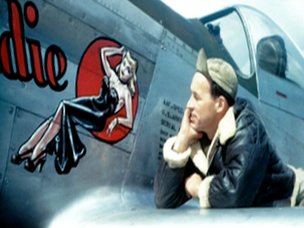
A pin-up girl is a woman whose physical attractiveness, entices one to place a picture of her on a wall. A term first attested to in English in 1941; however the practice is documented back at least to the 1890s.
The "pin up" images could be cut out of magazines or newspapers, or be from postcard or chromo-lithographs, and so on. Such photos often appear on calendars, which are meant to be pinned up anyway. |
|
Birds, Bees and Cavemen
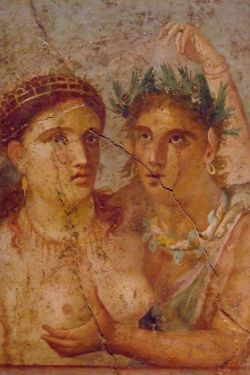
From the Paleolithic cave paintings of Madrid, to the numerous artifacts left us by the ancient Greeks, there’s no doubting that erotic imagery has played a part in the psyche of mankind for a very long time. Carnal pleasures and the simple beauty of the naked human form continue to inspire masterpieces across the globe, and in every art form possible. In our stories, in our music: Sexual Healing anybody? It’s a well known fact that the Greek Gods had a habit of coming down for a little carnal interaction with the mortals – stories which stir our souls and pique our imaginations even now; thousands of years after first being told. Of course a lot has changed in that time. By modern standards The Ancient Greeks were unashamed of the nude figure; they painted sexual scenes on their ceramics and the original Olympics were contested by naked athletes! Of course only males competed, still… I believe it safe to say, the other competitors wobbly bits out on show would be too much distraction for most of today’s athletes; be they male or female. In the Roman world, erotic art was also part of everyday life: Frank sexual depictions were found in public marketplaces, as murals and sculptures. |
|
The Dark Ages and the Bonfire of the Vanities
Then along comes one Emperor Constantine in the Fourth Century. Christianity is by this point the official religion of the state and “immoral” “pagan” imagery is banished. Thus we have: the Dark Ages – beyond religious artifacts, and decorative arts – there is little representation of sacrilegious pleasures. Poor Medieval fellows eh, good thing they had the crusades to keep them busy.
Then along comes one Emperor Constantine in the Fourth Century. Christianity is by this point the official religion of the state and “immoral” “pagan” imagery is banished. Thus we have: the Dark Ages – beyond religious artifacts, and decorative arts – there is little representation of sacrilegious pleasures. Poor Medieval fellows eh, good thing they had the crusades to keep them busy.
Let there be LIGHT... and nudes.
|
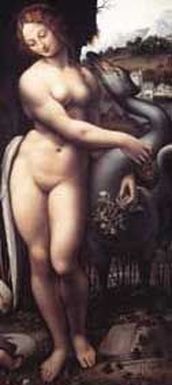
Thankfully… we grew weary of the Dark Ages and when a merchant class could support artists instead of just The Church, a new definition of feminine beauty was brought about in The Renaissance: a cultural movement that spanned roughly the 14th to the 17th century, beginning in Florence in the Late Middle Ages and later spreading to the rest of Europe.
Giants like: Da Vinci (1452-1519), Michaelangelo (1475-1564) and Titian (1485-1576) walked the earth. And with villas, and municipal buildings–and surprisingly even churches and cathedrals–to decorate in the city states of Italy, the myths and historical figures of ancient Rome provided ample material. The birth of Venus and other fables provided convenient excuses to display comely nudes. |
|
And the Shadow of Censorship
|
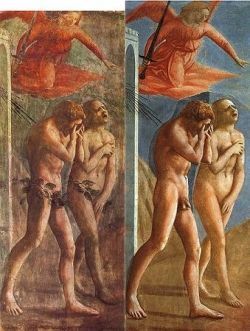
Although it should be mentioned that, along with this new freedom of portraying nudity and sensuality in Renaissance paintings came a corresponding urge to censor “obscene” images. Daniele da Volterra was hired to paint over the genitals and buttocks of figures in The Last Judgment, and many sculptures had robes or loincloths added after the fact to make the image more “chaste” for the religious figures of the day. Masaccio’s The Expulsion From the Garden of Eden was one classic example of this censorship, as seen in the accompanying image.
This ham-handed censorship notwithstanding, the Renaissance was a golden age for painters and sculptors to celebrate the human form in both secular and sacred artwork. During the 1800s, the art-world saw movements to escape the excesses of the Baroque and Rococo periods and return to classical simplicity. Neoclassicism was formalized in Europe as an outgrowth of Academic Art and again the popular characters from the past were represented by mostly nude models. |
|
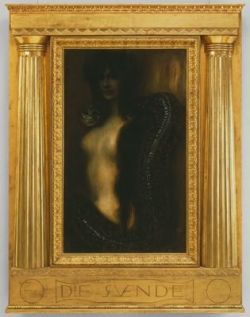
In the 19th Century, Classicism was taken to an extreme by the Pre-Raphaelites. While their strict adherence to Renaissance styles didn’t last, their works were very influential.
The seemingly opposed domains of the religious and the erotic were frequently merged in vanguard imagery of the 1880s and 1890s. There was a strong tradition on which the artist could now draw, ranging from works by British Pre-Raphaelites such as Dante Gabriel to the German artist Franz von Stuck’s extremely popular and provocative canvas Sin.
The seemingly opposed domains of the religious and the erotic were frequently merged in vanguard imagery of the 1880s and 1890s. There was a strong tradition on which the artist could now draw, ranging from works by British Pre-Raphaelites such as Dante Gabriel to the German artist Franz von Stuck’s extremely popular and provocative canvas Sin.
The American Pin Up
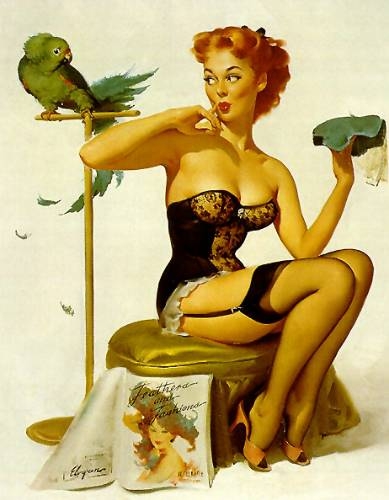
Early American influences in magazine and print illustration include Howard Pyle (1853-1911), his Brandywine school and students such as N. C. Wyeth (1882-1945). John La Gatta (1894 – 1976) and Andrew Loomis (1892-1959) were also major forces in magazine and advertising illustration. Meanwhile in Europe decorative Art Nouveau movements were also contributing to the artistry and styles of the times.
Lithography and then the birth of photography followed soon after were also bringing new techniques for printing. The adoption of the offset method at the turn of the twentieth century allowed for larger, faster and better quality printing. This made printed materials available to a vast public, posters of “pin-up girls” were now being mass-produced; the Golden Age of Illustration had begun.
Conveniently placed from 1880 to 1920, The Golden Age brought us development of economical high speed printing and an increased literacy. Creating a tremendous audience for the only available forms of mass communications at the time: Books, papers and magazines and bringing us artists such as: Alberto Vargas, and George Petty.
Lithography and then the birth of photography followed soon after were also bringing new techniques for printing. The adoption of the offset method at the turn of the twentieth century allowed for larger, faster and better quality printing. This made printed materials available to a vast public, posters of “pin-up girls” were now being mass-produced; the Golden Age of Illustration had begun.
Conveniently placed from 1880 to 1920, The Golden Age brought us development of economical high speed printing and an increased literacy. Creating a tremendous audience for the only available forms of mass communications at the time: Books, papers and magazines and bringing us artists such as: Alberto Vargas, and George Petty.
Calendar Girls & Candy Boxes
|
At the turn of the century, the calendar was the most prominent form of pin-up material, especially the early “glamour girl” formats by Angelo Asti.
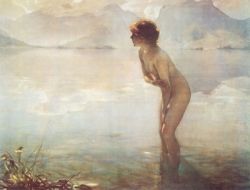
In 1913 the controversial nude ‘September Morn’ by Paul Chabas was censored by the New York Society for the Supression of Vice. A fact which did not stop it from being printed on literally hundreds of thousands of calendars, as well as; candy boxes, postcards and more. The Art Deco period also made respectable any art featuring romantic nudity, such as that of Mabel Rollins Harris, Maxfield Parrish and Hy Hintermeister. |
|
Mmmm... Mayonnaise...
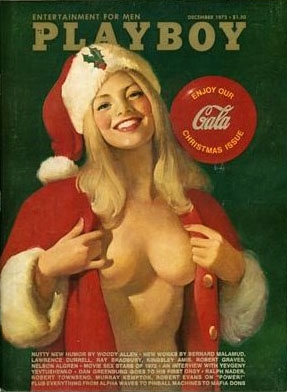
Many pin-ups were photographs of celebrities considered to be sex symbols. One of the most popular early pin-up girls was Betty Grable. Her poster was in the lockers of G.I.’s during World War II. Other pin-ups were artwork, often depicting idealized versions of what some thought a particularly beautiful or attractive woman should look like. Provocative images, particularly used in advertising, trod a thin line between sex and commerce; drawing on figures like Marilyn Monroe, or an anonymous sex symbol.
Additionally, there are several contemporary artists such as John Kacere – The subject of his Photorealistic paintings were exclusively the mid section of the female body. Although in the early 1980s he did branch away from this theme and included the entire body of a female in lingerie, only to then return to his original mid-section of the female body in 1988.
Perhaps more importantly there was also Haddon Sundblom – If anyone was responsible for the explosion of vibrant beautiful pitchwomen, it was this Chicago artist. Best remembered for his advertising work, specifically the Santa Claus advertisements he painted for The Coca-Cola Company in the 1930s, giving us the larger-than-life, grandfatherly Claus image which is still used by Coca-Cola to this day. Meanwhile his lush oil technique was influencing a roster of important pin-up artists.
The most famous being Gil Elvgren, who worked at Sundblom’s Stevens-Gross advertising agency along with such notable artisans as Al Buell, Harry Ekman, Bill Medcalf and Joyce Ballantyne. Their technique of using thick layers of paint to achieve a warmth and glow was dubbed ‘the mayonnaise school’.
Additionally, there are several contemporary artists such as John Kacere – The subject of his Photorealistic paintings were exclusively the mid section of the female body. Although in the early 1980s he did branch away from this theme and included the entire body of a female in lingerie, only to then return to his original mid-section of the female body in 1988.
Perhaps more importantly there was also Haddon Sundblom – If anyone was responsible for the explosion of vibrant beautiful pitchwomen, it was this Chicago artist. Best remembered for his advertising work, specifically the Santa Claus advertisements he painted for The Coca-Cola Company in the 1930s, giving us the larger-than-life, grandfatherly Claus image which is still used by Coca-Cola to this day. Meanwhile his lush oil technique was influencing a roster of important pin-up artists.
The most famous being Gil Elvgren, who worked at Sundblom’s Stevens-Gross advertising agency along with such notable artisans as Al Buell, Harry Ekman, Bill Medcalf and Joyce Ballantyne. Their technique of using thick layers of paint to achieve a warmth and glow was dubbed ‘the mayonnaise school’.
|
For Better or For Worse
Beyond the Golden Age In 1953 Playboy created a sensation with their centerfold of Marilyn Monroe. Until that point, it was mostly Esquire who provided opportunities for a generation of pin-up artists; although they had presented photographic pinups previously, these had never contained overt nudity. Then in 1970 Penthouse introduced the world to pubic hair. The introduction of explicit men’s magazines made the saucy depictions of ‘the mayonnaise school’ seem quaint and old-fashioned as further advances in Photographic technology brought us quicker easier means of satisfying the pressures of monthly deadlines. \ These days a person could be forgiven for thinking nudity and the “Pin up” are no longer relevant subjects in what constitutes good art. At a glance today’s sex symbols are seemingly comprised of mostly pre-packaged teen sensations and anorexic ‘supermodels’ . |

|
While the art-world itself seems to have suffered something of a demise in modern times too – a subject which I could write a whole other lens on, but instead I shall simply furrow my brow while typing: Damien Hirst… and move right along.
Fortunately what passes as art to the cognoscenti does not have to be what passes as art to the rest of us. Let them fork out there preposterous sums of money on tanks of formaldehyde and bovine carcasses.
If you, like me have more an eye for the sensual, than the sensational, and little to no interest in owning something as ugly as half a dead cow, but do appreciate the simple sensual beauty of the human form then Zazzle has some real gems for you.
Fortunately what passes as art to the cognoscenti does not have to be what passes as art to the rest of us. Let them fork out there preposterous sums of money on tanks of formaldehyde and bovine carcasses.
If you, like me have more an eye for the sensual, than the sensational, and little to no interest in owning something as ugly as half a dead cow, but do appreciate the simple sensual beauty of the human form then Zazzle has some real gems for you.
|
Hand-Drawn Sexy Ladies
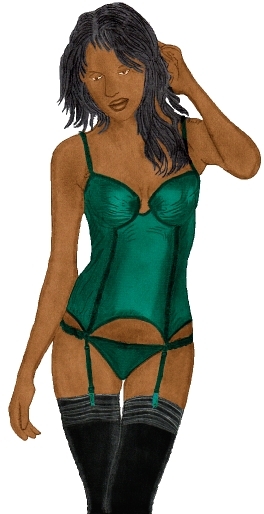
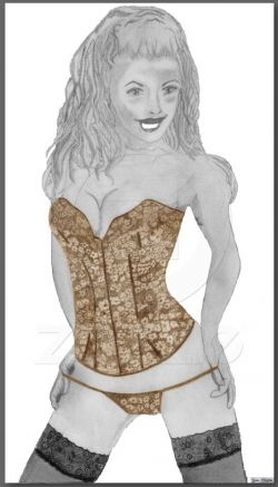
Among the thousands of talented artists working hard to bring good art to the masses, many are still making time to pay homage to the natural beauty of the female form with some truly stunning art. At Hand-Drawn we’re working hard to prove showmanship does not have to surpass beauty. Not only are we constantly adding to the Sexy Ladies section of our own Zazzle store.. A collection you’ll want to revisit often as we also intend to keep adding to it. And the best part: these beauties are affordable; with the large range of products available at Zazzle you can now own beautiful pin up’s on anything from Key-chains, to Bumper stickers, or go all out: to show off the true splendour of these works with Zazzle Posters; made with premium UV-resistant archival ink, and available on seven different media, from basic poster paper to canvas. They won’t set you back as much as a dead cows head but they sure do look fine. |
|
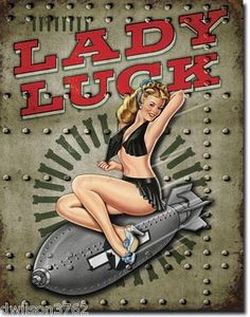
We've come a long way from when classic 1940's era pin-ups decorated the nose cones of Allied bombers during World War II, but the classic pin-up motif is still quite popular. There are many great collections of pin-up art available from Amazon, we've picked a few out for you below.
Copyright © 2010-2014, The Hand-Drawn Stores. All images used with permission, subject to copyright of their respective owners. All rights reserved.